The SlicedTube class
Main author: Simon Rohou
A SlicedTube is a tube defined over a shared TDomain.
For each temporal slice stored in the temporal partition, the tube owns one Slice object storing its codomain over that temporal support. The codomain type is typically Interval or IntervalVector, or any domain type defined by the user. The same temporal domain can be shared by many tubes.
Creating sliced tubes
In Codac C++, SlicedTube is a generic class template SlicedTube<T>. The codomain type T is not restricted to intervals or boxes: in principle, any domain type compatible with the sliced-tube API can be used.
In practice, the most common sliced-tube types are:
SlicedTube<Interval>,SlicedTube<IntervalVector>,SlicedTube<IntervalMatrix>.
These standard tube types are also the ones exposed in the Python and Matlab bindings.
In C++, template argument deduction is available for the constructors based on the arguments. In the examples below, comments make the deduced type explicit when useful.
A sliced tube can be created from:
a constant codomain,
an analytic function of one scalar variable,
a sampled or an analytic trajectory,
or another sliced tube (copy constructor).
td = create_tdomain([0,10], 0.1, True)

# Sliced tube from interval-type codomains
x = SlicedTube(td, Interval(-1,1))
y = SlicedTube(td, IntervalVector(2))
z = SlicedTube(td, IntervalMatrix(2,2))

# From an analytic function
t = ScalarVar()
f = AnalyticFunction([t], sin(t))
xf = SlicedTube(td, f)

# From an analytic trajectory or sampled trajectory
at = AnalyticTraj([0,10], AnalyticFunction([t],cos(t)))
st = AnalyticTraj([0,10], AnalyticFunction([t],cos(t)+t/10)).sampled(1e-2)
xu = SlicedTube(td,at) | SlicedTube(td,st) # union (hull) of tubes

fig.plot_tube(xf, [Color.dark_blue(),Color.light_gray()])
fig.plot_tube(xu, [Color.dark_blue(),Color.light_gray()])
auto td = create_tdomain({0,10}, 0.1, true);

// Sliced tube from interval-type codomains
SlicedTube x(td, Interval(-1,1)); // x has type SlicedTube<Interval>
SlicedTube y(td, IntervalVector(2)); // y has type SlicedTube<IntervalVector>
SlicedTube z(td, IntervalMatrix(2,2)); // z has type SlicedTube<IntervalMatrix>

// Explicit template notation remains possible:
SlicedTube<Interval> x2(td, Interval(-1,1));

// From an analytic function
ScalarVar t;
AnalyticFunction f({t}, sin(t));
SlicedTube xf(td, f);
// xf has type SlicedTube<Interval> because f outputs scalar values

// From an analytic trajectory or sampled trajectory
AnalyticTraj at({0,10}, AnalyticFunction({t},cos(t)));
SampledTraj st = AnalyticTraj({0,10}, AnalyticFunction({t},cos(t)+t/10)).sampled(1e-2);
auto xu = SlicedTube(td,at) | SlicedTube(td,st); // union (hull) of tubes

fig.plot_tube(xf, {Color::dark_blue(),Color::light_gray()});
fig.plot_tube(xu, {Color::dark_blue(),Color::light_gray()});
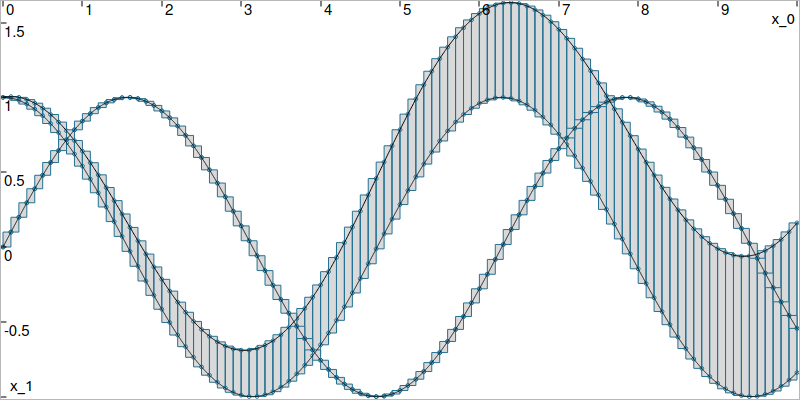
Created tubes \([x_f](\cdot)=[\sin(\cdot),\sin(\cdot)]\) and \([x_u](\cdot)=[\cos(\cdot),\cos(\cdot)+\frac{\cdot}{10}]\), made of 100 slices.
Basic properties
A sliced tube exposes:
size()for the codomain dimension,shape()for matrix-like codomain shapes,tdomain()andt0_tf()from the base classes,nb_slices()for the number of temporal elements,codomain()for the global codomain hull,volume()for the sum of non-gate slice volumes,is_empty()andis_unbounded().
Accessing slices and iterating
You can access the first and last slices directly:
first_slice()last_slice()
and you can retrieve a slice from a temporal-domain iterator or from a TSlice pointer.
The class also defines custom iterators so that iterating on a SlicedTube yields application-level Slice objects rather than raw TSlice objects.
td = create_tdomain([0,3])
x = SlicedTube(td, IntervalVector(2))
x.set([[1,5],[-oo,2]], [0,1])
x.set([[2,8],[-oo,3]], [1,2])
x.set([[6,9],[-oo,4]], [2,3])

s0 = x.first_slice()
s1 = s0.next_slice()

for s in x:
  print(s.t0_tf(), s.codomain())
auto td = create_tdomain({0,3});
SlicedTube x(td, IntervalVector(2));
x.set({{1,5},{-oo,2}}, {0,1});
x.set({{2,8},{-oo,3}}, {1,2});
x.set({{6,9},{-oo,4}}, {2,3});

auto s0 = x.first_slice();
auto s1 = s0->next_slice();

for(const auto& s : x)
  std::cout << s.t0_tf() << " -> " << s.codomain() << std::endl;
Setting values and refining the partition
A sliced tube can be updated globally or locally:
set(codomain)sets all slices to the same codomain,set(codomain, t)sets the value at one time instant,set(codomain, [ta,tb])sets all temporal elements intersecting an interval,set_ith_slice(codomain, i)sets one stored slice by index.
The key point is that local assignments may refine the underlying TDomain.
For example, setting a value at one scalar time creates an explicit gate if necessary. Similarly, setting a value over an interval may create new temporal boundaries at the interval endpoints.
Note
Because the temporal domain is shared, such refinements are structural operations. If several tubes share the same TDomain, all of them will observe the new partition.
td = create_tdomain([0,2], 1.0, False) # False: without gates

x = SlicedTube(td, Interval(0,1))
v = SlicedTube(td, Interval(-1,1))

print(x)            # outputs [0,2]->[0,1], 2 slices
print(v)            # outputs [0,2]->[0,1], 2 slices

n = td.nb_tslices() # 2: [0,1],[1,2]
x.set([0.5,1], 1.3) # local update, will refine the partition at t=1.3
m = td.nb_tslices() # now 4: [0,1],[1,1.3],[1.3],[1.3,2]

print(x)            # outputs [0,2]->[-1,1], 4 slices
print(v)            # outputs [0,2]->[-1,1], 4 slices (v is also impacted by x.set(..))
auto td = create_tdomain({0,2}, 1.0, false); // false: without gates

SlicedTube x(td, Interval(0,1));
SlicedTube v(td, Interval(-1,1));

cout << x << endl;   // outputs [0,2]->[0,1], 2 slices
cout << v << endl;   // outputs [0,2]->[0,1], 2 slices

size_t n = td->nb_tslices(); // 2: [0,1],[1,2]
x.set({0.5,1}, 1.3);         // local update, will refine the partition at t=1.3
size_t m = td->nb_tslices(); // now 4: [0,1],[1,1.3],[1.3],[1.3,2]

cout << x << endl;   // outputs [0,2]->[-1,1], 4 slices
cout << v << endl;   // outputs [0,2]->[-1,1], 4 slices (v is also impacted by x.set(..))
Evaluation
A sliced tube \([x](\cdot)\) can be evaluated over a temporal interval \([t]\) with x(t). The implementation walks through all relevant temporal slices, evaluates each local slice, and unions the results. If the query interval is not included in the temporal domain, the result is the unbounded value of the codomain type (for interval tubes: \([-\infty,\infty]\)).
When a derivative tube v is available, the overload x(t,v) uses per-slice derivative-aware evaluation and unions the resulting enclosures. This is available for Interval and IntervalVector codomain types.
td = create_tdomain([0,3], 1.0, False)
x = SlicedTube(td, Interval())

x.set([1,5], [0,1])
x.set([2,8], [1,2])
x.set([6,9], [2,3])

x(0.5)      # [1,5]
x(1.5)      # [2,8]
x([0,3])    # [1,9]
x(-1.0)     # [-oo,oo]

# No explicit gates: boundary values come from adjacent-slice intersections
x(1.0)      # [2,5]
x(2.0)      # [6,8]
x(3.0)      # [6,9]
auto td = create_tdomain({0,3}, 1.0, false);
SlicedTube x(td, Interval());

x.set({1,5}, {0,1});
x.set({2,8}, {1,2});
x.set({6,9}, {2,3});

Interval y0 = x(0.5);   // [1,5]
Interval y1 = x(1.5);   // [2,8]
Interval y2 = x({0,3}); // [1,9]
Interval y3 = x(-1.0);  // [-oo,oo]

// No explicit gates: boundary values come from adjacent-slice intersections
Interval y4 = x(1.0);   // [2,5]
Interval y5 = x(2.0);   // [6,8]
Interval y6 = x(3.0);   // [6,9]
Inversion
The inversion of a sliced tube \([x](\cdot)\), denoted \([x]^{-1}([y])\), is defined by
It is illustrated by the figure below. Intuitively, the inversion returns the set of time values whose image under \([x](\cdot)\) intersects the target set \([y]\).
Depending on the overload, the invert() methods
invert(y, t=[...])invert(y, v_t, t=[...])invert(y, v, t=[...])invert(y, v_t, v, t=[...])
return either:
one interval enclosing the union of all preimages,
or the different connected components of the inversion in a vector of
Intervalobjects.
When a derivative tube v is provided, Codac uses derivative information slice by slice in order to compute sharper inverse images.
The following example computes the different connected components of the inversion \([x]^{-1}([0,0.2])\) over a temporal subdomain, and then draws their projections in red.
v_t = []
y = Interval(0,0.2)
x.invert(y,v_t)

for t in v_t:
  z = cart_prod(t,y)
  DefaultFigure.draw_box(z, Color.red())
std::vector<Interval> v_t;
Interval y(0,0.2);
x.invert(y, v_t);

for(const auto& t : v_t)
{
  IntervalVector z = cart_prod(t,y);
  DefaultFigure::draw_box(z, Color::red());
}
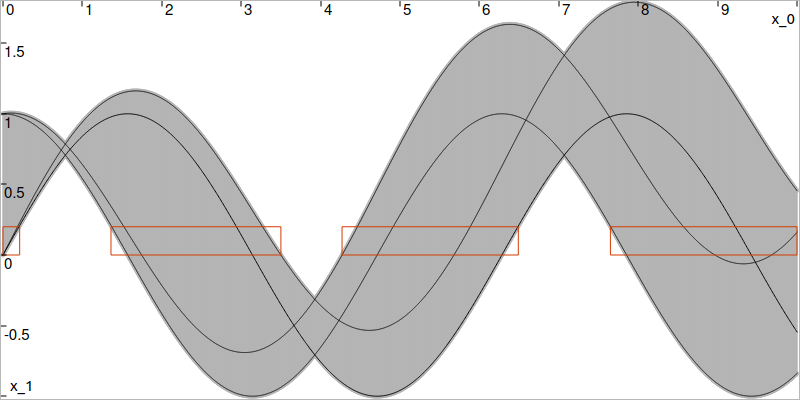
Example of tube inversion for a given tube \([x](\cdot)\). The red boxes correspond to the connected components of \([x]^{-1}([0,0.2])\).
- group Inversion of sliced tubes
Functions
-
inline Interval invert(const T &y, const Interval &t) const
Returns the interval inversion \(\left[[x]^{-1}([y])\right]\).
If the inversion results in several pre-images, their union is returned.
- Parameters:
y – interval codomain
t – (optional) temporal domain on which the inversion will be performed
- Returns:
the hull of \([x]^{-1}([y])\)
-
inline void invert(const T &y, std::vector<Interval> &v_t, const Interval &t) const
Computes the set of continuous values of the inversion \([x]^{-1}([y])\).
- Parameters:
y – interval codomain
v_t – vector of the sub-tdomains \([t_k]\) for which \(\forall t\in[t_k] \mid x(t)\in[y], x(\cdot)\in[x](\cdot)\)
t – (optional) temporal domain on which the inversion will be performed
-
inline Interval invert(const T &y, const SlicedTube<T> &v, const Interval &t) const
Returns the optimal interval inversion \(\left[[x]^{-1}([y])\right]\).
The knowledge of the derivative tube \([v](\cdot)\) allows a finer inversion. If the inversion results in several pre-images, their union is returned.
- Parameters:
y – interval codomain
v – derivative tube such that \(\dot{x}(\cdot)\in[v](\cdot)\)
t – (optional) temporal domain on which the inversion will be performed
- Returns:
hull of \([x]^{-1}([y])\)
-
inline void invert(const T &y, std::vector<Interval> &v_t, const SlicedTube<T> &v, const Interval &t) const
Computes the set of continuous values of the optimal inversion \([x]^{-1}([y])\).
The knowledge of the derivative tube \([v](\cdot)\) allows finer inversions.
- Parameters:
y – interval codomain
v_t – vector of the sub-tdomains \([t_k]\) for which \(\forall t\in[t_k] \mid x(t)\in[y], x(\cdot)\in[x](\cdot), \dot{x}(\cdot)\in[v](\cdot)\)
v – derivative tube such that \(\dot{x}(\cdot)\in[v](\cdot)\)
t – (optional) temporal domain on which the inversion will be performed
-
inline Interval invert(const T &y, const Interval &t) const
Tube operations
Standard pointwise operations are available on sliced tubes and are applied slice by slice.
For two tubes, binary operators require both operands to share the same TDomain. This makes tube expressions easy to combine once the tubes have been built on a common temporal support.
The following operators are available:
union and intersection:
|and&,arithmetic operations:
+,-,*,/,in-place variants:
|=,&=,+=,-=,*=,/=.
For scalar interval tubes, several usual nonlinear functions are also provided, including sqr, sqrt, pow, exp, log, sin, cos, tan, atan2, abs, min, max, sign, floor and ceil.
td = create_tdomain([0,2], 1.0, False)

x = SlicedTube(td, Interval(1,2))
y = SlicedTube(td, Interval(-1,3))

z_add = x + y  # addition of two tubes
z_mul = 2 * x  # multiplication by a scalar/interval
z_hul = x | y  # hull (union) of two tubes
z_int = x & y  # intersection of two tubes

u = sin(x) + exp(y)
auto td = create_tdomain({0,2}, 1.0, false);

SlicedTube x(td, Interval(1,2));
SlicedTube y(td, Interval(-1,3));

auto z_add = x + y;  // addition of two tubes
auto z_mul = 2. * x; // multiplication by a scalar/interval
auto z_hul = x | y;  // hull (union) of two tubes
auto z_int = x & y;  // intersection of two tubes

auto u = sin(x) + exp(y);
For vector-valued codomains, pointwise arithmetic is also available. In particular, the product of a matrix tube and a vector tube returns a vector tube.
A = SlicedTube(td, IntervalMatrix(2,2))
b = SlicedTube(td, IntervalVector(2))

y = A * b
SlicedTube A(td, IntervalMatrix(2,2));
SlicedTube b(td, IntervalVector(2));

auto y = A * b; // type: SlicedTube<IntervalVector>
Integration and primitives
Reliable integral computations are available on tubes.
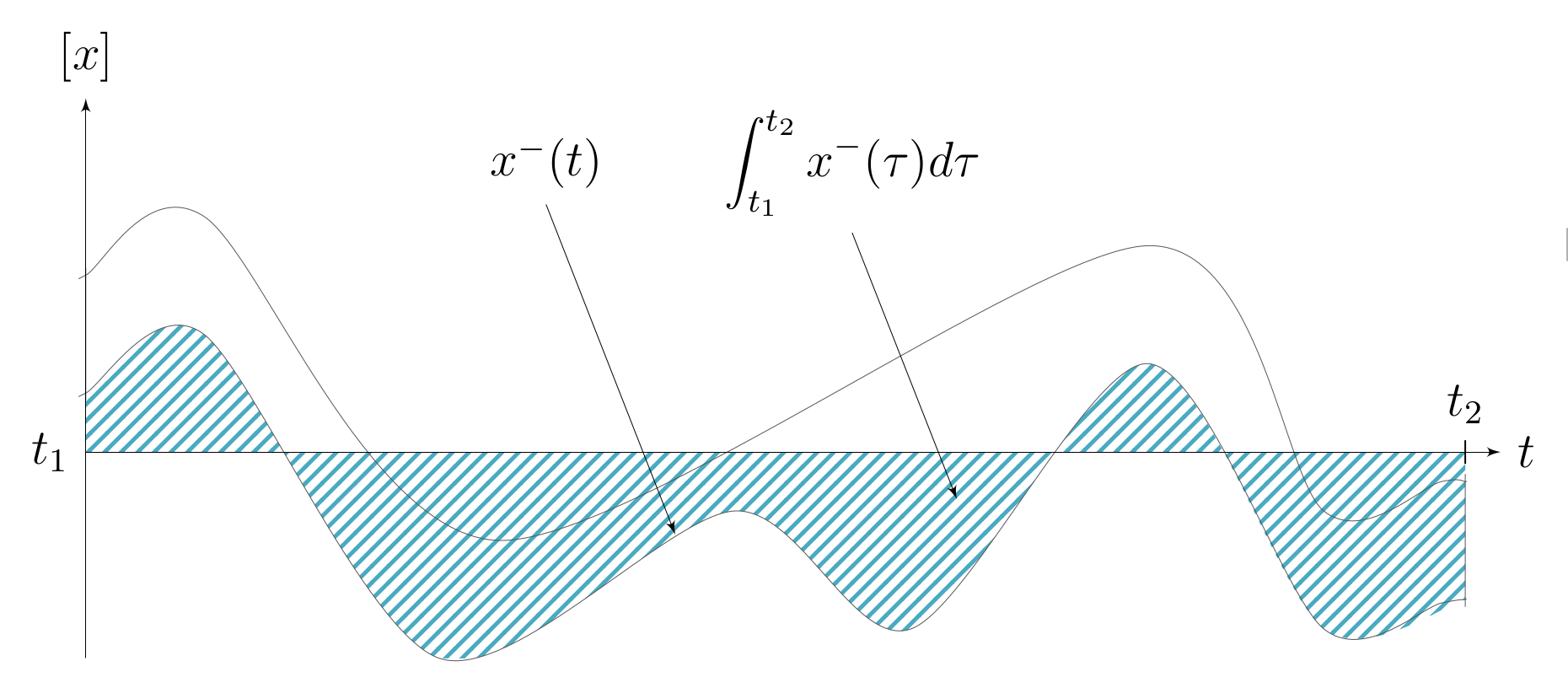
Hatched part depicts \(\int_{a}^{b}x^-(\tau)d\tau\), the lower bound of \(\int_{a}^{b}[x](\tau)d\tau\).
The computation is reliable even for tubes defined from analytic functions, because it stands on the tube’s slices that are reliable enclosures. The result is an outer approximation of the integral of the tube represented by these slices:
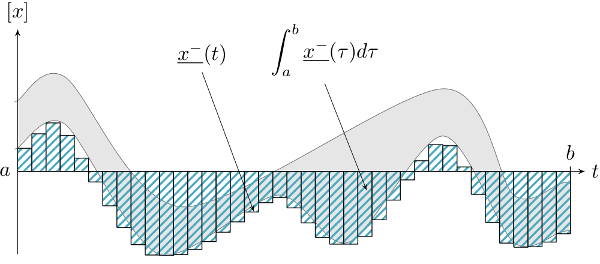
Outer approximation of the lower bound of \(\int_{a}^{b}[x](\tau)d\tau\).
- group Integration and primitive operations on sliced tubes
The following methods are valid for tubes defined for
IntervalorIntervalVectorcodomains. The returned values are integral enclosures of same type (respectively,IntervalorIntervalVector).Functions
-
T integral(const Interval &t) const
Returns an enclosure of the integrals of this tube from \(t_0\) to \([t]\).
This method computes an enclosure of
\[ \left\{ \int_{t_0}^{\tau} [x](s)\,ds \;\middle|\; \tau\in[t] \right\}. \]It is obtained from
partial_integral(t)by taking the hull between the lower bound of the lower enclosure and the upper bound of the upper enclosure.- Parameters:
t – temporal interval \([t]\)
- Returns:
enclosure of the integrals of this tube over
t
-
T integral(const Interval &t1, const Interval &t2) const
Returns an enclosure of the integrals of this tube between the time intervals \([t_1]\) and \([t_2]\).
This method computes an enclosure of
\[ \left\{ \int_{\tau_1}^{\tau_2} [x](s)\,ds \;\middle|\; \tau_1\in[t_1],\ \tau_2\in[t_2] \right\}. \]The result is obtained by subtracting the partial integral enclosures at
t1andt2.- Parameters:
t1 – first temporal interval \([t_1]\)
t2 – second temporal interval \([t_2]\)
- Returns:
enclosure of the integrals of this tube between
t1andt2
-
std::pair<T, T> partial_integral(const Interval &t) const
Returns lower and upper enclosures of the integrals of this tube \([x](\cdot)=[x^-(\cdot),x^+(\cdot)]\) from \(t_0\) to \([t]\).
This method returns a pair \(([p^-],[p^+])\) such that:
\[ [p^-]\supset \left\{ \int_{t_0}^{\tau} x^-(s)\,ds \;\middle|\; \tau\in[t] \right\} \mathrm{~~and~~} [p^+]\supset \left\{\int_{t_0}^{\tau} x^+(s)\,ds \;\middle|\; \tau\in[t] \right\}. \]This representation preserves more information than
integral(t), which only returns the hull of these partial integral bounds.- Parameters:
t – temporal interval \([t]\)
- Returns:
pair of lower and upper partial integral enclosures over
t
-
std::pair<T, T> partial_integral(const Interval &t1, const Interval &t2) const
Returns lower and upper enclosures of the integrals of this tube \([x](\cdot)=[x^-(\cdot),x^+(\cdot)]\) between \([t_1]\) and \([t_2]\).
This method returns a pair obtained by subtracting the partial integral enclosures at
t1from those att2. The returned pair \(([p^-],[p^+])\) is such that:and\[ [p^-]\supset \left\{ \int_{\tau_1}^{\tau_2} x^-(s)\,ds \;\middle|\; \tau_1\in[t_1],\ \tau_2\in[t_2] \right\}, \]\[ [p^+]\supset \left\{\int_{\tau_1}^{\tau_2} x^+(s)\,ds \;\middle|\; \tau_1\in[t_1],\ \tau_2\in[t_2] \right\}. \]- Parameters:
t1 – first temporal interval \([t_1]\)
t2 – second temporal interval \([t_2]\)
- Returns:
pair of lower and upper enclosures of the integrals
-
inline SlicedTube<T> primitive() const
Returns a primitive of this tube with zero initial condition.
This is a shorthand for
primitive(x0)with \(x_0 = 0\).In other words, the returned tube encloses solutions of
\[ \dot{p}(\cdot) \in [x](\cdot), \qquad p(t_0)=0. \]- Returns:
primitive tube with zero initial condition
-
inline SlicedTube<T> primitive(const T &x0) const
Returns a primitive of this tube with prescribed initial condition.
This method constructs a tube
pon the same temporal domain as this tube, imposes the initial condition \(p(t_0)=x_0\), and contractspwith this tube through the derivative relation usingCtcDeriv.In other words, the returned tube encloses solutions of
\[ \dot{p}(\cdot) \in [x](\cdot), \qquad p(t_0)=x_0. \]Note
The current implementation may create an explicit gate at the initial time \(t_0\) if it is not already present in the temporal partition.
- Parameters:
x0 – initial condition at \(t_0\)
- Returns:
primitive tube satisfying the prescribed initial condition
-
T integral(const Interval &t) const
Inflation, extraction, and algebraic helpers
A sliced tube can be inflated either by a constant radius or by a time-varying sampled radius. Inflation is performed in place.
x.inflate(0.2) # constant inflation

rad = SampledTraj({0.0:0.1, 1.0:0.3, 2.0:0.2})
x.inflate(rad) # time-varying inflation radius
x.inflate(0.2); // constant inflation

SampledTraj<double> rad({{0.0,0.11}, {1.0,0.3}, {2.0,0.2}});
x.inflate(rad); // time-varying inflation radius
For vector-valued tubes, the API also provides convenient extraction operators:
x[i]returns the \(i\)-th scalar component as aSlicedTube,x.subvector(i,j)returns a subvector tube.
The extracted tubes keep the same temporal partition as the original one.
# Component and subvector extraction
x0 = x[0]
x12 = x.subvector(1,2)
// Component and subvector extraction
auto x0 = x[0];              // type: SlicedTube<Interval>
auto x12 = x.subvector(1,2); // type: SlicedTube<IntervalVector>
Involving a tube in an analytic expression
The method .as_function() wraps a sliced tube as an analytic operator so that it can be embedded inside analytic expressions. This is a convenient bridge between the tube API and the analytic-expression API, see the section on temporal operators for its use.